The whole game, from zero to X-books
Written by the guy who built the tracker. Read this before you touch anything else on the site.

Last summer I was farming sweepstakes casinos. Then my state banned them, which is a strange thing to have happen to your income, and I spent a couple of weeks not sure what to do with the habits I had built.
I moved to sports arbitrage because it was the obvious next thing. I made about a hundred dollars a day for a while, and then the books figured out what I was and limited me one after another. So I went looking again, and what I found was bonus conversion, which some people call matched betting. I paid a random guy on Discord to teach me. It was worth it. Then I built the tool I wished he had given me, because everything that existed cost between $80 and $500 a month and none of it covered the books I was actually using.
These days I push somewhere between $10,000 and $20,000 of wagering volume through my accounts on a normal day. It takes about 90 minutes, and I do not care who wins a single one of those games. That last part is the whole point, and if it sounds strange now it will make sense by the end of this page.
What follows is everything, every mechanic and every trap I know about. If you have farmed an airdrop you will recognize all of it. If you have never placed a bet you will still be able to follow it, because I wrote the odds section for you. And if you have been grinding +EV and arbs for years, there are two sections in here that I think will make you a little angry you did not know them sooner.
There is a glossary at the bottom if a word trips you up.
Why the ground is moving
Every edge in this market has had a season, and the American version of this market is only a few years old, so the seasons have been short.
It started with directional betting, which is just picking a side and being right more often than the price implies. A few people were genuinely good at it. Most were not, and the ones who were got limited anyway, because a book does not need you to be a fraud to stop wanting your business. It only needs you to be profitable.
Then came +EV. Instead of predicting outcomes you look for prices that are wrong, and you bet the wrong price. That worked, and it still works, but the crowd found it and the books got faster at correcting their numbers, so the edge got thinner and the accounts got shorter.
Then arbitrage. You take both sides of the same game at two different books and lock in the difference. The math is clean and no opinion is required, which is why so many people liked it. It worked right up until the books learned exactly what an arber looks like, and now they close those accounts on sight.
The reason I stopped chasing those edges is that they all die the same way. Somebody notices, the book adjusts, and the opportunity is gone. The edge I settled on is different because the books pay for it on purpose.
Sportsbooks spend billions of dollars acquiring customers. That spending shows up as bonus bets, deposit matches, reload offers and free plays, and it sits in their public financials under marketing. Unlike a mispriced line, a promotion does not close the moment someone notices it. It is a coupon with a cash value, handed out in the open, and almost nobody stops to calculate what it is actually worth.
What is live right now is bonus conversion, and the best of it is offshore. The regulated US books are pulling back on promotions. The offers are smaller, the terms are tighter, and in some states the promo bets now get taxed like real money. Offshore books are not bound by any of that. They cannot compete with FanDuel on the app, so they compete for the same attention using exactly the tools the regulated books are giving up. That is the window, and I do not think it stays open forever.
There is one more thing going on in the background. Sweepstakes casinos, which is where a whole generation of people learned to farm promotions, have now been banned in 13 states, six of them this year. That skill set did not expire when the sites did. It just needs somewhere to point.
How wild west this actually is
From the conversations I have every week, in the Discord and with people who sign up, awareness of this game comes in three tiers, and almost nobody is on the top one.
The first tier is the domestic crowd. They know FanDuel gives you $200 for a $5 bet, and some of them even hedge it. They stack their state's welcome offers, cash out, and assume the game is over. Most of them have never heard the word reload. They do not know offshore books exist as a category, let alone that offshore is where the recurring money is.
The second tier is the offshore crowd. They found the deposit matches, they know the reload rhythm, they have eaten a slow withdrawal or two, and they treat the big offshore names as the whole second layer. If you ask them about X-books, most of them will ask you what that is.
The third tier is a handful of people who noticed that a sportsbook can now be nothing more than an X account with a pinned deposit ladder, and that those ladders are the richest promotions anywhere in the market.
What makes this a wild west is that every tier thinks it is at the top. The information is not hidden. It is just uncollected, sitting in a hundred Discord servers and group chats and nobody's notes. An edge that dies when people notice would have died by now. This one is still growing because most of the people who could notice are busy on tier one.
The airdrop analogy, stated once
If you have farmed a single airdrop you already understand this game, and you just need the dictionary.
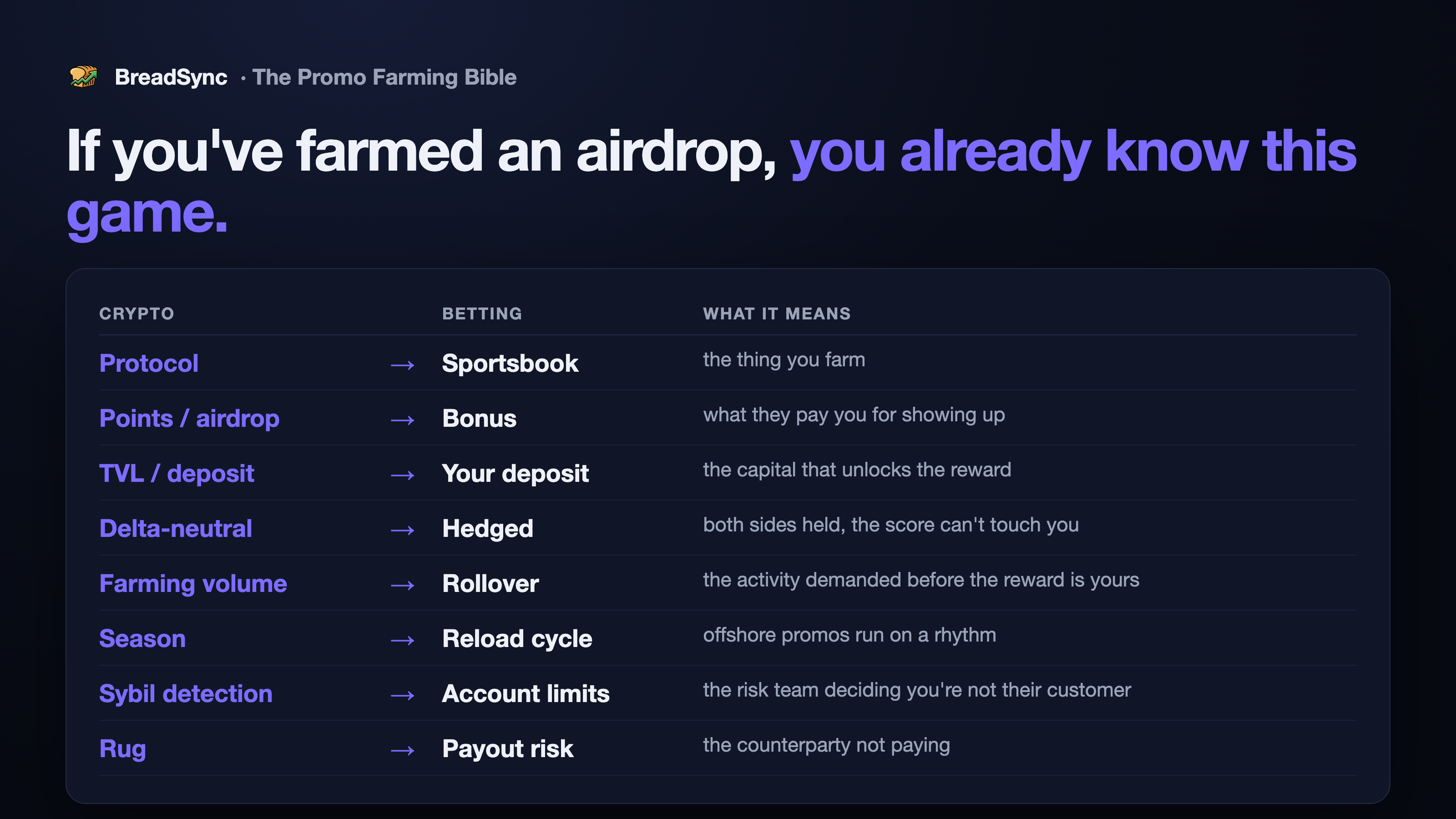
- Protocol → sportsbook. The thing you farm.
- Points or airdrop → bonus. The thing they give you for showing up.
- TVL → your deposit. The capital that unlocks the reward.
- Delta-neutral → hedged. You hold both sides, so the final score cannot touch you.
- Farming volume → rollover. The activity the protocol demands before the reward is yours.
- Season → reload cycle. Offshore books run promos on a rhythm the way protocols run seasons.
- Sybil detection → account limits. The risk team deciding you are not the customer they wanted.
- Rug → payout risk. The counterparty not paying. This is the number one fear and the number one thing to manage.
- Bridging → funding. Getting capital in and out of the venue.
The whole game in one sentence is this: deposit into a venue that pays a reward for activity, generate the activity while hedged so the outcome cannot hurt you, collect the reward, withdraw, and move to the next venue. That is airdrop farming, and it is also this.
Odds in sixty seconds
Skip this if you already bet. If you do not, this is the only vocabulary you need for the rest of the page.
American odds are a price tag. A negative number tells you how much you risk to profit $100, so at -130 you risk $130 to make $100, and at -250 you risk $250. A positive number tells you how much you profit on a $100 risk, so at +130 you make $130 and at +250 you make $250. Plus 100 is even money.
A true coin flip gets priced at -110 on both sides. That extra ten cents on each side is the juice, which is the book's commission, and it is baked into every line you will ever see. If you add both sides of a market together and subtract 100, what is left is the hold. A lot of what you do in this game is finding ways to shrink that number.
Only three markets matter here. The moneyline is who wins. The spread is who wins by how much. The total is whether the combined score goes over or under a number. Everything on this page uses those three and nothing else, and later on I will explain why sticking to them is also how you keep your accounts alive.
What you are actually farming
A bonus is not free money. It is a coupon with a chore attached, and before any of the mechanics make sense you have to know exactly which coupon you were handed, because everything downstream depends on it.
Site credit, sometimes called a cash bonus, behaves like cash when you bet it. If you win, both your stake and your winnings come back to you. The catch is that it stays locked behind rollover until you have wagered enough to clear it. This is the best kind of bonus and also the rarest. Only a handful of books offer it.
A free play, which most books call a bonus bet, is a single-use token. If it loses, it cost you nothing. If it wins, you keep the winnings and only the winnings, because the stake was never yours and never comes back. This is what most books hand out, and it is the reason a $300 free play is not worth $300. It is worth whatever you can convert it into, which is usually somewhere between 55% and 75% of the face value.
Insurance offers go by a lot of names: no sweat, second chance, bet reset. They only pay if your first bet loses. That means they convert at roughly half the rate of a bonus that pays every time, and it means the biggest advertised number on the board is very often the worst offer on the board.
The chore is rollover, which some books call playthrough. It is the total amount you must wager before the money attached to the bonus becomes withdrawable.
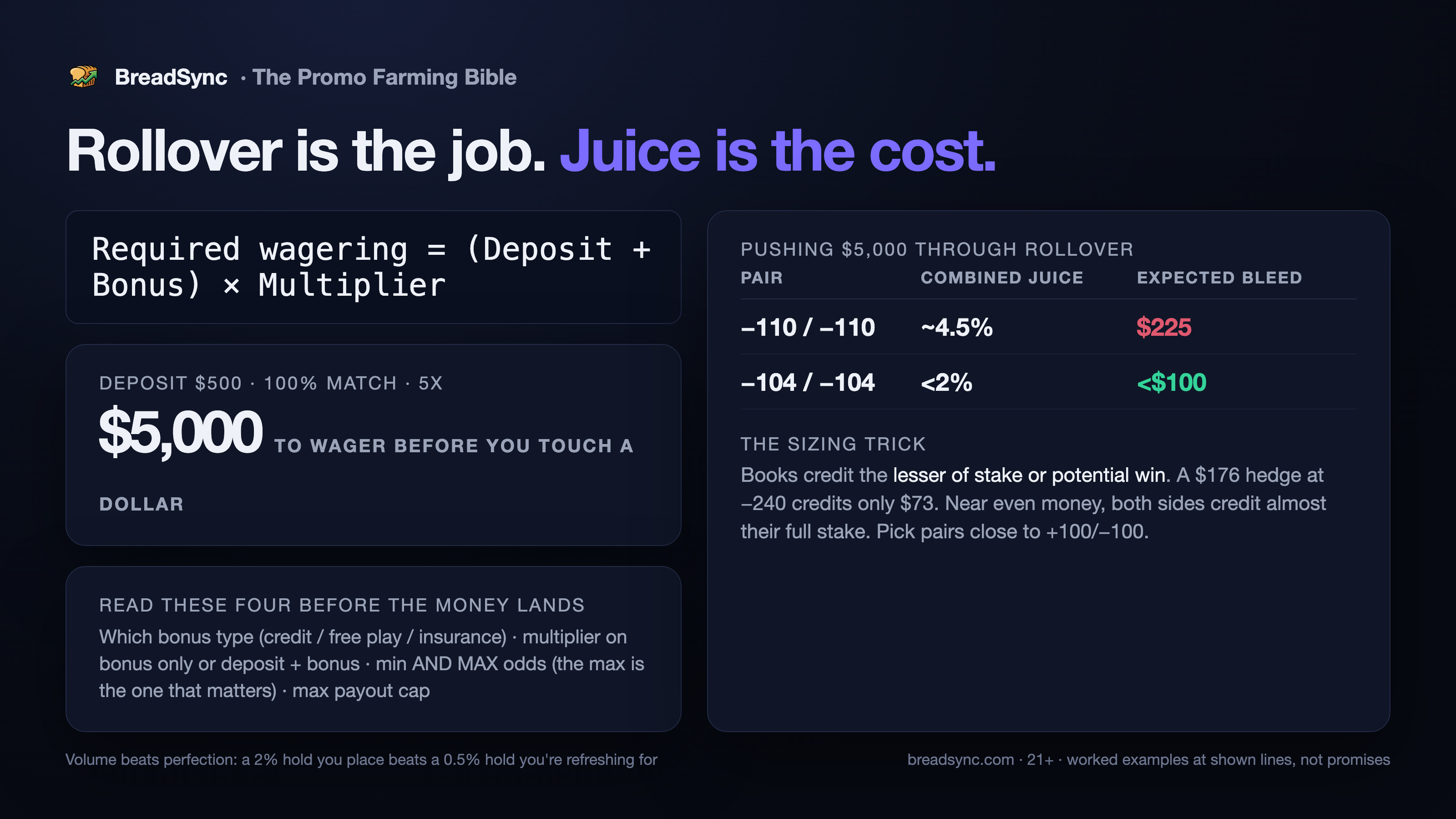
Required wagering = (Deposit + Bonus) × Multiplier
Say you deposit $500 and get a 100% match, with 5x rollover on deposit plus bonus. You now owe the book $5,000 of wagers before you can touch a dollar. The book is betting that its juice claws the bonus back over that much volume. Your entire job is getting through the volume while bleeding as little as possible, and the rest of this page is mostly about how.
Four lines in the terms decide whether a bonus is good or a trap, and I read all four before any money lands, every time.
The first is what type of bonus it actually is. Site credit, free play, or insurance behave completely differently, and the promo banner will not tell you which one you are getting. The second is what the multiplier applies to, because bonus only and deposit plus bonus are a factor of two apart in how much work you owe. The third is the minimum and maximum odds for qualifying bets. The minimum is a nuisance, since some books will not count a bet at -300 toward rollover. The maximum is the one that changes your math by ten times as much, because it caps what a free play can convert at, and it is the difference between the 71% and the 58% you are about to see. The fourth is any maximum payout on bonus-attached winnings. Some books cap it at a multiple of the bonus, which quietly puts a ceiling on your upside without ever saying so on the banner.
If you want to see what your state's welcome offers are actually worth once all four lines are accounted for, that is what the deposit calculator does. Pick a state, put in a number, and it shows you the cash that comes back rather than the number on the banner.
The hedge: going outcome-neutral
This is the delta-neutral part, and it is the single mechanic the whole game runs on. Once it clicks, everything else on this page is just variations.
You place the free play on one side of a game at one book. You place real cash on the other side of the same game at a different book. One side wins and the other loses, and you do not care which, because you sized the two bets so that you come out in the same place either way.
I did not understand this the first time a book handed me a bonus bet. I put it on a four-leg parlay, because that is what the app was nudging me toward, and it lost the way four-leg parlays usually do. I remember thinking that was just what free bets were for. It took me an embarrassingly long time to realize the book wanted me to do exactly that.
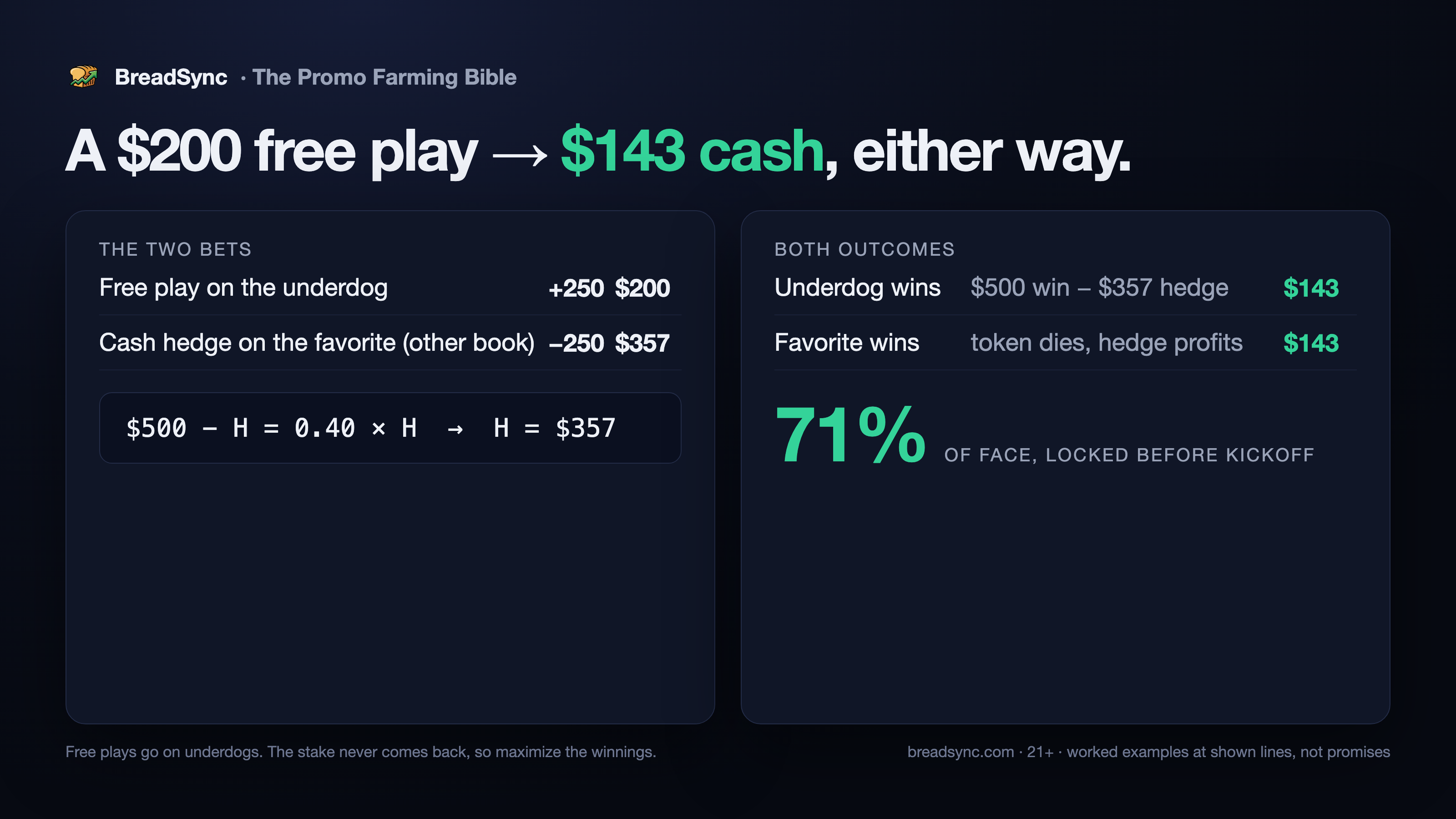
Here is what I should have done. Say you have a $200 free play.
You put the free play on the underdog at +250. If it hits, it pays $500 in winnings. Then you put real cash on the favorite at -250 at a different book, which profits forty cents for every dollar you stake. Now you size the hedge, call it H, so that both outcomes land in the same place:
$500 − H = 0.40 × H
H = $357
If the underdog wins, you collect $500 and lose the $357 hedge, so you keep $143. If the favorite wins, the free play dies, which cost you nothing, and the hedge returns $143 in profit, so you keep $143. The token converted at 71%, and the game stopped mattering to you before kickoff.
Free plays go on underdogs, and the reason is worth understanding rather than memorizing. The stake on a free play never comes back, so you want to make the winnings portion as large as possible relative to it. Two hundred dollars on a -200 favorite wins you $100. The same $200 on a +250 underdog wins you $500. The token is the same, and the outcome for you is very different.
Now the trap, and this one costs people real money. Most books cap the odds you are allowed to place a free play at, usually somewhere between +130 and +160. I found this out at a bet slip, after I had already placed the cash side at the other book, when the free play side came back rejected for exceeding the cap. I had to re-size the whole thing in a hurry against a worse number. Here is what that looks like with the same $200 token at a +140 cap:
$280 − H = 0.714 × H
H = $163
Both outcomes now land at $117, which is 58%. Thirteen points of conversion evaporated because of one line in the terms. So at a capped book you are no longer hunting the longest dog on the board. You are hunting the tightest pair at or under the cap, which is a different search.
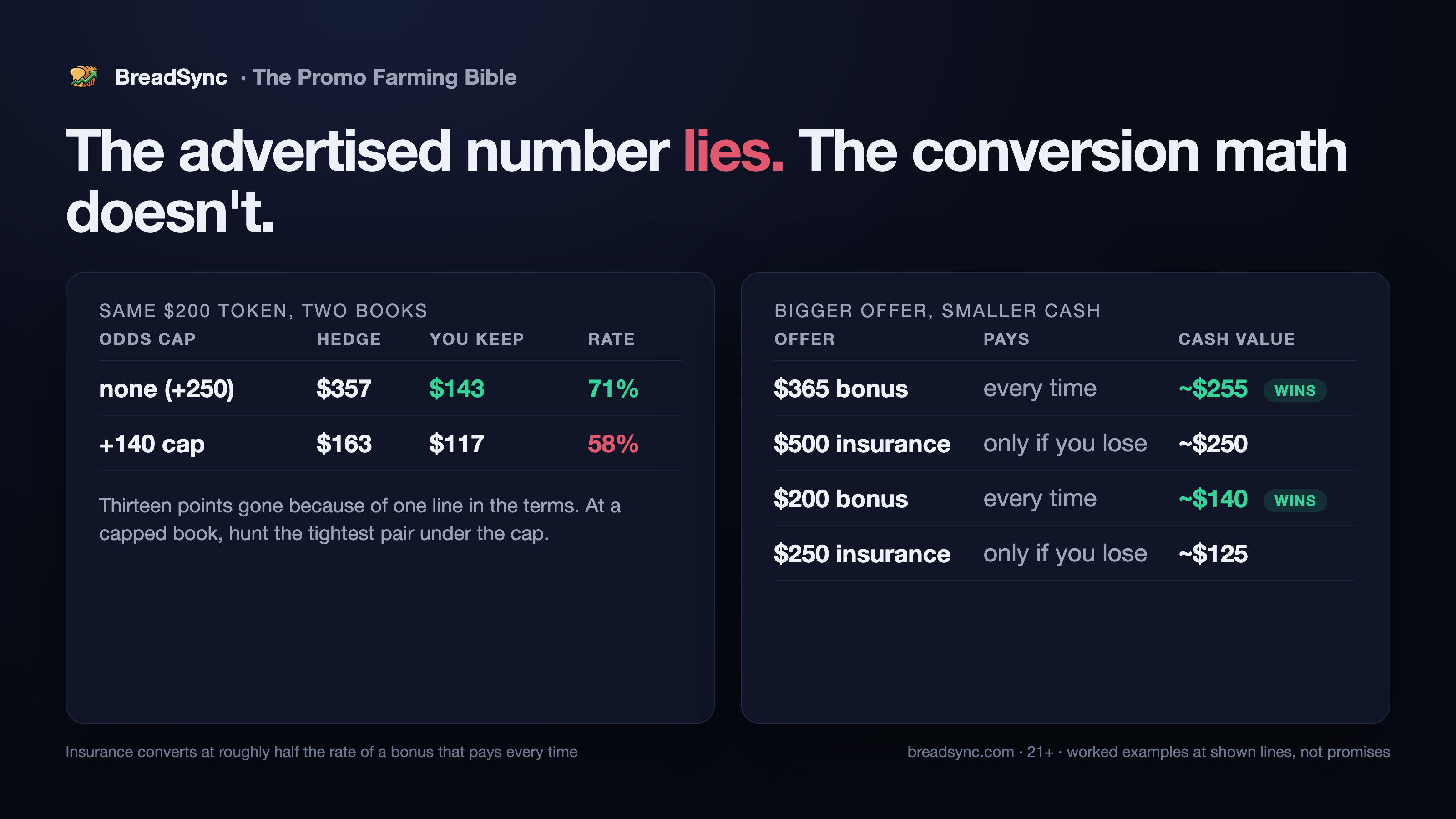
One more example, because the advertised numbers lie in a specific way. Run a $365 bonus that pays every time through the same math and it comes out around $255 in cash. Run a $500 insurance offer that only pays if you lose and it comes out around $250. The smaller offer wins. A $200 bonus at one book beats a $250 insurance offer at another for the same reason. The number on the banner does not tell you the order. Only the conversion math does.
This sizing is the thing I got wrong most often by hand, and it is the first thing I built. The free bet converter in BreadSync finds the pair, sizes the hedge, and knows each book's odds cap so it never hands you a number the bet slip will reject. It is part of the free account, so if you want to run your first token through it, make one and start there.
Rollover: where the actual work is
Everyone writes guides about the hedge. The hedge is ten minutes. Rollover is the job, and it is where the skill actually lives, which is why I spend more time on it than anything else in this guide.
You clear rollover with low holds. A low hold is the same bet placed on both sides across two books, with the pair chosen so that the combined juice is as close to zero as you can find. You are not trying to win. You are trying to push volume through both accounts while losing as little as possible to the commission.
The numbers show why the pair matters. A normal spread at -110 on both sides carries about 4.5% combined juice. Push $5,000 of rollover through at that price and you expect to lose about $225 doing it. A well-chosen two-book pair at -104 on both sides is under 2%, so the same $5,000 of volume costs you less than $100. That gap, repeated across every book you run for as long as you run them, is most of your profit.
A perfect low hold looks like Lakers -140 for $700 at one book and Heat +140 for $500 at the other. Either outcome returns exactly what you put in. A realistic one looks more like -140 for $500 against +125 for $381, which costs you 2.7% of the total staked, about $24, to push $881 of volume through two books at once.
How I run them:
- Find a two-book pairing with combined juice somewhere in the 1% to 3% range. Anything in that band works.
- Main markets only. Moneyline, spread, total. Big leagues, big games.
- Bet both sides at the calculated stakes, and log both.
- Repeat until the rollover is cleared.
The rule that separates the people who make money at this from the people who do not is that volume beats perfection. A 2% hold you actually place beats a 0.5% hold you are still refreshing the screen for. The bottleneck in this game is wagering volume, and every day a bonus sits unconverted is bankroll doing nothing while a clock runs toward the bonus expiring. If your weekly average hold is under 2%, you are doing the job. I track the average and try not to think too hard about any individual bet.
Finding those pairs by hand across more than two or three books is where I lost most of my time before I built the low hold finder. It looks across every book you have an account at, ranks the cheapest pairs, and sizes them. That one is part of Pro. The tracker that logs the bets and keeps your rollover balances straight is free, and honestly the tracker is where I would start if I were you, because knowing exactly what you owe at each book is half of not getting stuck.
The sizing trick nobody tells you
This is a subtlety worth real money whenever your converted cash is about to feed a rollover, and I have never seen it written down anywhere else.
Most books count the lesser of your stake or your potential win toward playthrough. So a $176 hedge at -240 credits only about $73 of rollover, because that is the potential win, rather than the $176 you actually wagered. A $100 bet at +250 credits only $100, the stake, rather than the $250 it could have won. In both cases you burned real money on the conversion and got almost no rollover progress at either book for it.
Compare that to a conversion placed near even money. At -110 on both sides, each leg credits close to its full stake, and one hedge knocks down rollover at both books at once.
The practical rule is that when you have a choice between conversion pairs, take the one closest to +100 and -100 on both sides, even if the face conversion rate is slightly worse. The rollover progress you get for free usually pays that difference back several times over.
The loop
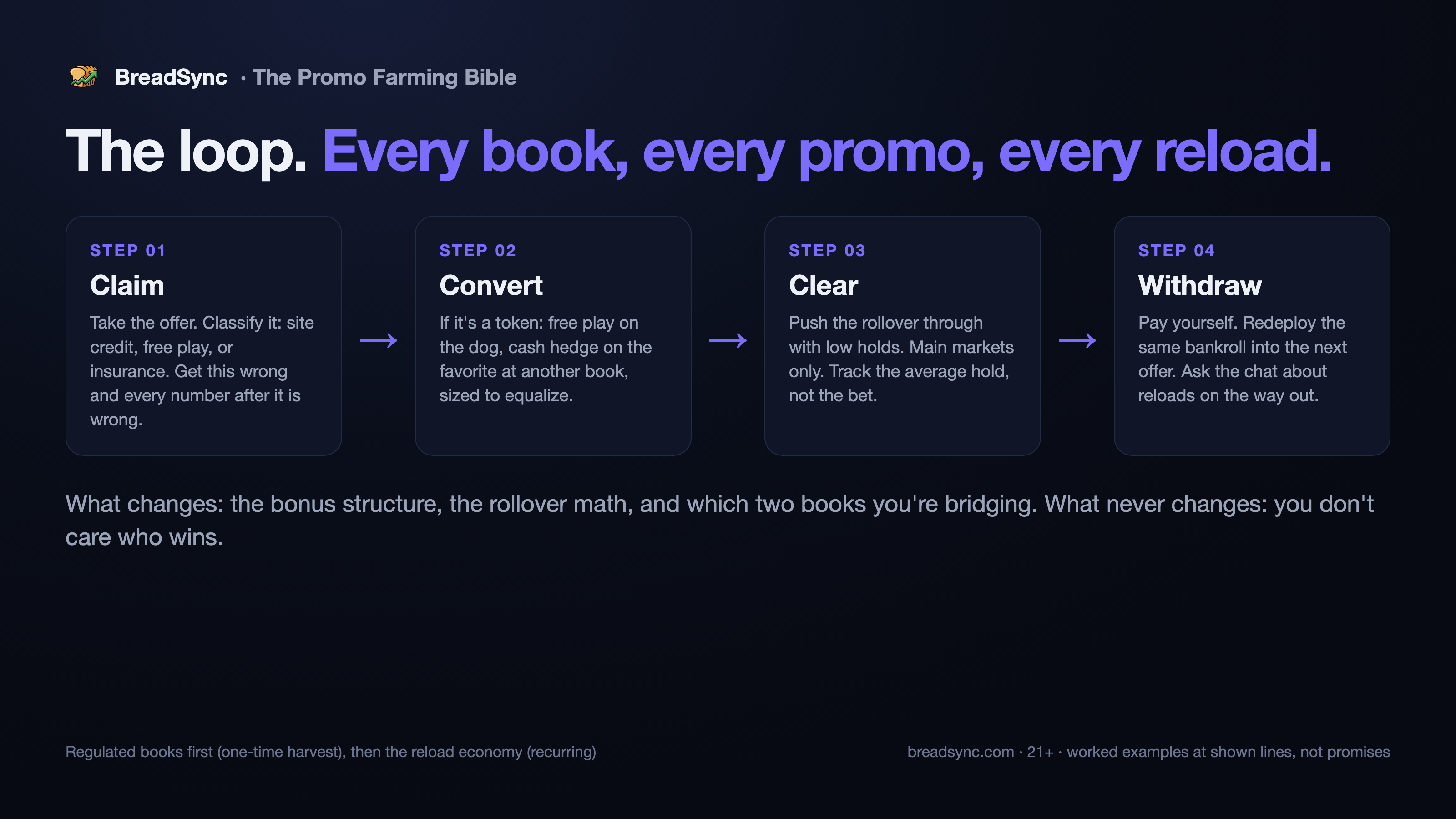
Once you have the pieces, the game is the same four steps forever.
First you claim the offer and classify exactly what you were given: site credit, free play, or insurance. If you get this wrong, every number after it is wrong too. Second, if it is a token, you convert it, free play on the dog and cash hedge on the favorite, sized to equalize. Third, you clear the rollover with low holds, bleeding as little juice as possible. Fourth, you withdraw and redeploy the same bankroll into the next offer.
Every book, every promo, every reload runs through those four steps. What changes is the bonus structure, the rollover math, and which two books you happen to be bridging that week.
Sequencing: regulated first, then the reload economy
Start with the regulated books, and finish them before you go anywhere else.
They pay out in a day, usually less. Their terms are clean, and most welcome offers carry zero rollover or a single 1x. Stack every welcome offer available in your state: FanDuel, DraftKings, BetMGM, Caesars, bet365, Fanatics, BetRivers, Hard Rock, theScore, whichever of them operate where you live. In a typical legal state that stack is worth upwards of $3,000 in total bonus value, all of it convertible with the hedge math above. Take the bigger offers first, since the math scales linearly and you only get one welcome bonus per book.
Fund them with PayPal linked to a bank account, which is the fastest rail in both directions. Debit cards are fine for deposits and awkward for withdrawals. Avoid credit cards, because some banks code sportsbook deposits as cash advances and charge you accordingly.
That is a one-time harvest. Five to ten books in your state, then it is over, and this is where most people stop. The deposit calculator will show you the exact stack for your state and what it is worth at whatever bankroll you have, which is a useful thing to look at before you fund anything. The recurring supply, though, is the second layer.
Offshore books are licensed abroad and do not check which state line you live behind. They compete on reloads: deposit matches from 75% to 200%, weekly free plays, crypto match bonuses stacked on top of the base match, higher limits, and noticeably more tolerance for players who win. Some of them have sharp lines and thin promotions, which makes them the fair side of a low hold. Others are bonus factories with soft lines, which makes them the promo side. You pair one kind against the other.
I want to say the trade-offs plainly, because nobody else does. Withdrawals take days rather than hours. Crypto is the main rail, so there is an exchange step at each end. There is no regulator to complain to, and your only leverage is the book's reputation. Rollover is heavier than at domestic books. And these books are not licensed in your state, which means it is on you to know your own state's law before you touch one. If you farmed sweeps casinos for years, you already accepted this exact risk profile, whether or not you thought about it that way.
X-books are the newest shape of all this. Picture a sportsbook whose entire storefront is an X account: verified, tens of thousands of followers, based somewhere in Central America, with a bio that is just a list of payment apps. The pinned post is a deposit ladder. Deposit $200 and get an $80 free play, deposit $500 and get $200, on up to $5,000 for $2,000. Free-play giveaways drop on the timeline. Reloads go to active accounts. Everything closes in DMs.
Run that ladder through the math above and it stops looking like a giveaway and starts looking like a spreadsheet. Two hundred dollars for an $80 free play is a 40% match, and at a +150 odds cap that token converts to about $48 in cash. A 100% match with no rollover, which some of these books run on promo days, is the best-structured offer in all of betting on the days it appears.
The question that gets you better promos
I found this one by accident. I opened a live chat to ask about a withdrawal, and the agent, unprompted, offered me a deposit match that was nowhere on the promo page. I have asked every time since.
Before you fund any new account, open the book's live chat and ask one thing: "What promotions are available to me right now?"
Agents routinely have access to deposit matches, free plays, and reload offers that are not on the public promo page, and they can attach a better offer to your incoming deposit if you ask before the money lands. Once you have cycled a book a few times and reached whatever informal VIP tier they keep, the offers from that chat window get noticeably more aggressive. Personalized reloads start there.
Use the same chat to confirm the terms in writing: the multiplier, what it applies to, the minimum odds, the time limit. Save the transcript. If a dispute ever happens, that transcript is your evidence, and I have needed it.
Ask again on the way out, too. Books offer reloads to recent depositors that never appear anywhere public.
The rollover elimination play
If you take one advanced idea from this page, take this one. It is the biggest efficiency gain in the whole system, and it is the thing the +EV and arb crowd never learned, because they never had to clear rollover.
A normal low hold grinds rollover down slowly on both books at once. Every $1,000 of volume reduces $1,000 of rollover at book A and $1,000 at book B, and it stays linear like that until you are done. The elimination play sizes the bet so that one book loses its entire balance in a single wager, and it turns out that changes the math a lot.
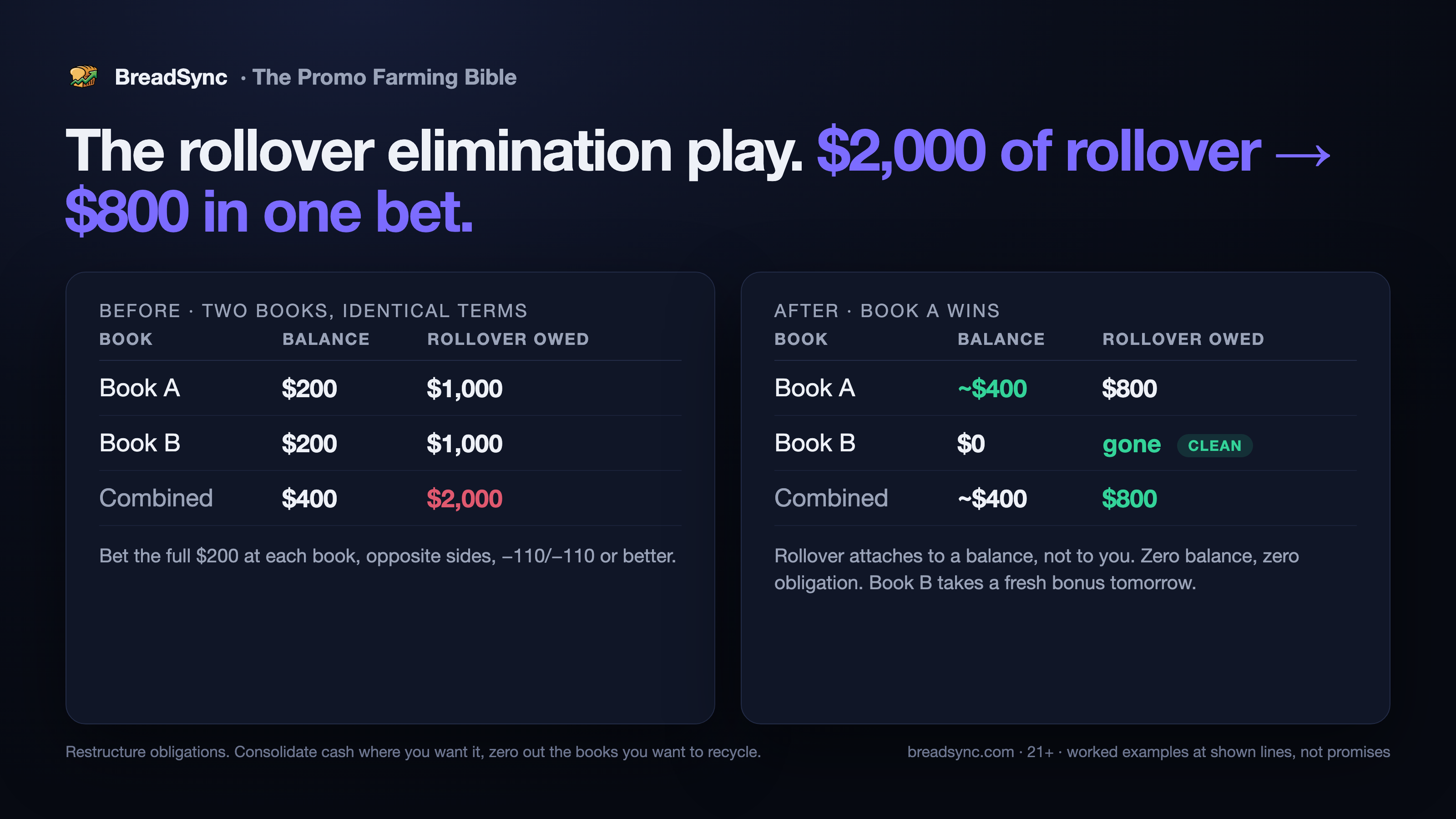
Work it through. Two books with identical terms: deposit $100, get a $100 bonus, 5x rollover on deposit plus bonus. Each book has a $200 balance and $1,000 of rollover owed, so combined you have $400 of cash and $2,000 of rollover.
Pin them against each other on a near-even market, -110 on both sides or better, and wager the full $200 at each book on opposite sides of the same game.
Book A wins, and its balance climbs to about $400. It used $200 of rollover, so $800 remains. Book B loses, and its balance is zero. It also used $200 of rollover, and $800 technically remains, on an account with no money in it.
Here is the asymmetry that makes this work. Rollover is a requirement on a balance, not a debt you owe. When the balance is zero, the rollover attached to it vanishes. There is no clawback, and the book does not chase you for unfinished playthrough.
So before, you had $400 of cash and $2,000 of rollover across two books. After, you have $400 of cash minus a few dollars of juice, $800 of rollover on one book, and a clean, empty second book that is ready to take a fresh welcome bonus or reload. You eliminated $1,000 of rollover in one transaction and manufactured a new bonus opportunity in the same move.
That reframed the whole game for me. I stopped thinking of low holding as clearing rollover on both books and started thinking of it as restructuring obligations: consolidate cash into the books where I want it, zero out the books I want to recycle.
There are conditions. Both books need real rollover left. Both need to accept main-market wagers near your balance size. You want a fresh bonus lined up for the book that is about to be emptied, and you want the line close to 50/50. Match the sizes so one book goes to exactly zero. Do not do it on your first cycle at a book. And check the max-bet cap on bonus funds first, because if the cap is below your balance, this book is not a candidate.
Stack this across four or five books in rotation and a bankroll that would otherwise grind through five parallel rollovers ends up cycling fresh bonuses two or three times faster. Combined with reloads on the winning side and welcome bonuses on the freshly emptied side, this is the mechanism that turns a one-time regulated harvest into a recurring loop.
Middles, for the arb crowd
Sometimes the two sides of a low hold do not perfectly overlap, and that is a feature rather than a mistake.
Take Lakers +3.5 at +120 on one book and Heat -2.5 at -140 on the other. If the Heat win by exactly three, both bets win. That is a middle-in, which is a low hold with a lottery ticket attached.
Now take Lakers -2.5 at +140 against Heat +1.5 at -110. If the Lakers win by exactly two, both bets lose. That is a middle-out. The worst case is bad, but every other outcome is a perfect low hold or an outright arb, and when you know the distribution you can price which one you want.
Push variants exist too, when the spread is a whole number and one side wins while the other pushes. Same logic. If you have been arbing, you already know how to think about all of this. The only difference here is that the goal is volume through rollover, so the middle is a bonus on top of the job rather than the job itself.
Account health: why you get limited and how to last longer
Every book runs a risk operation. It tracks behavior, flags profitable patterns, and limits accounts that look like a problem. None of it is a ban. You did not break a rule. They decided your pattern is not profitable for them, and they turn up the friction. Max bets drop from $1,000 to $200, the promo emails stop, and withdrawals start taking a week of "additional review."
Mine happened over about ten days. I had been running arbs across the same two books for a few weeks, and one morning my max bet at one of them was a fifth of what it had been the night before. No email, no warning. The promos just stopped arriving after that, and I understood I had been reclassified.
What they look for is consistently beating the closing line, heavy volume on soft markets like player props and obscure leagues, bet sizes with decimals in them, bets placed seconds after a line moves, and things like forty bets in two hours.
This is where the +EV and arb crowd should sit up, because an arb almost always means you bet a better number than the closing line at one of the two books. That is the exact behavior risk teams are paid to detect. One arb is fine. A pattern of them across weeks gets you limited. Low holds are the safer cousin: same mechanics, slightly worse math, dramatically less heat. If you are optimizing for how long the offers keep arriving rather than how much you squeeze from any single bet, that trade is worth making every time.
How to look like the customer they want:
- Major markets only. NFL, NBA, MLB, NHL, top college, top soccer, Grand Slam tennis. You blend into millions of casual bettors, and the lines are tight anyway.
- No props. They are priced inefficiently and watched closely.
- Vary your bet sizes like a person would. Round numbers, different amounts.
- Spread activity across days and games, and let deposit and withdrawal cycles breathe.
- Bigger bets on main markets read as a confident recreational whale, which is exactly the customer a book wants. Small scattered bets read as a bot.
- Do not bet the second a line moves.
Getting limited is a when, not an if. The goal is to extract as much bonus value as possible before it happens, and to keep enough accounts running in parallel that any single limit barely matters.
Bankroll: the binding constraint
The limit in this game is capital, not opportunity. There are always more offers than you have money to work.
That $200 token earlier needed $357 of real cash to hedge. Parallel rollover cycles need balances sitting at several books at once. So a smaller bankroll runs one or two regulated books at a time and finishes them fully before moving on. A mid-sized one runs two or three in parallel, then layers in the second-layer books. A larger one opens across both sides at once, biggest offers first.
The worst case in this game has a name, and the name is rollover jail. I spent most of a week there once, with almost everything I had sitting at one book under playthrough, unable to hedge because there was nothing liquid on the other side. All your money stuck at one book, and your only ways out are to deposit more or to +EV bet your way out. You avoid it by spreading across books, controlling bet sizes, and keeping liquid funds at a win book, meaning one with consistent, easy withdrawals, to hedge against. That way cash tends to flow toward the place you can pull it from.
A cycle ends one of two ways. Either you clear rollover with money left over, or variance runs your balance out before the rollover is finished. Both are normal. Over many cycles, if the low-hold discipline is real, the first outcome outweighs the second by a lot. When you do run out at a book, walk away clean. Do not deposit more to rescue a bonus that is already gone.
And pay yourself. Money in a book is not yours yet. It is yours when it lands in your wallet.
The free tracker exists because this is the part I kept getting wrong in a spreadsheet. It knows which balances are locked, which are withdrawable, and which book owes you money, and there is no limit on it. If you take nothing else from this page, set that up before your second book.
The risk stack
Some of this is mechanical. Lines move between your two placements. Bets get rejected. Voids settle asymmetrically. Every number on this page assumes both legs were accepted at the prices shown, and sometimes they are not.
Payout risk offshore is the whole game. The number one question in the scene is not "what's the promo," it is "did they pay." Never park more at one book than you can afford to have stuck there.
Taxes are real. Winnings are taxable income in the US, regulated or offshore, whether or not anyone sends you a form. Keep records and talk to a professional.
And then there is drift, which is the one that actually ruins people. You start clean. Then one day a game looks good, or a prop feels easy, or a bad cycle gets chased with a fresh deposit. That is not this game anymore. That is gambling, with worse math than a casual bettor has, because you have convinced yourself you are still doing something disciplined. Every bet you place should leave you neutral on the result. If you catch yourself rooting for a team during a low hold, you made a sizing mistake somewhere, and you should go find it.
The map: every way to farm this, ranked by effort
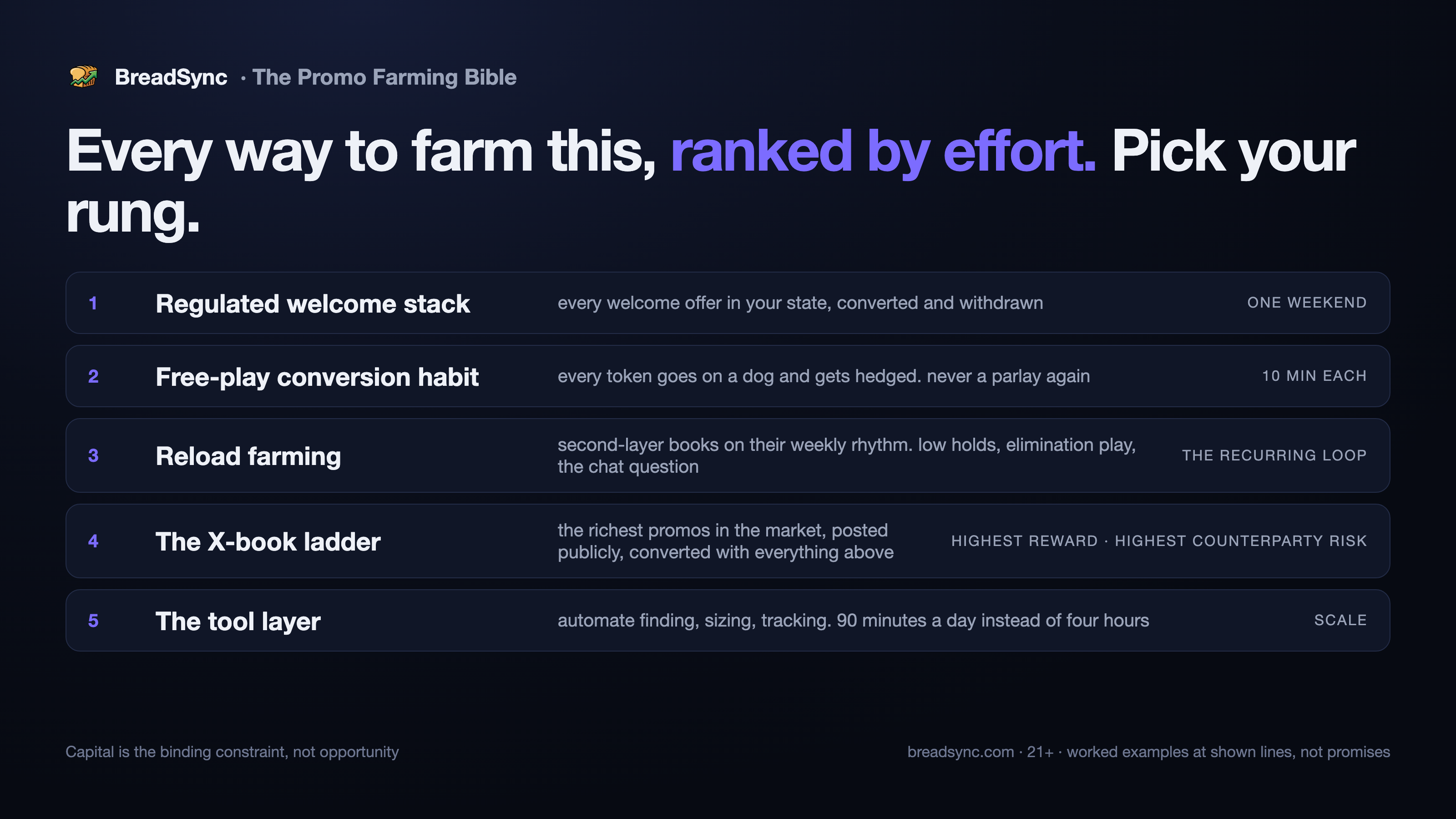
Pick your rung. There is no prize for starting higher than you are ready for.
- The regulated welcome stack. One weekend. Every welcome offer in your state, converted and withdrawn. It is finite and clean, and it is the best first money in betting.
- Free-play conversion as a habit. Every token any book ever hands you goes on a dog and gets hedged. Ten minutes each. Never fire a bonus bet at a parlay again.
- Reload farming. The second-layer books on their weekly rhythm. Low holds through rollover, the elimination play across pairs, the chat question every cycle. This is the recurring loop.
- The X-book ladder. The richest promos in the market, posted publicly, converted with everything above. Highest reward, highest counterparty risk, and the most manual.
- The tool layer. Automating the finding, sizing, and tracking so the whole thing takes 90 minutes a day instead of four hours.
Tools
You can run the first two rungs with a spreadsheet and a hedge calculator, and plenty of people do. The stake math for a single conversion fits on a napkin.
Past that, the method stops being a calculation and becomes an operation. You are holding tokens at several books with different odds caps. You have rollover balances at each of them that credit differently depending on the price you bet at. You need the cheapest pair across all of them every night, sized so the right book goes to zero when you want it to, and you need to know at any moment which balances are locked, which are withdrawable, and which book owes you money. Nothing else does this. That is not a sales line. It is the reason I had to build it.
BreadSync is the whole loop in one place. It pulls 100+ books, including the second layer and the X-books where the recurring promos live. It finds the conversion pair for whatever token you are holding and sizes the hedge against that book's odds cap, so the number it gives you is the number the bet slip accepts. It ranks low holds across every book you run for rollover. It tracks the elimination play. And the tracker knows the state of every dollar you have in play, because I got tired of a spreadsheet lying to me about it.
The tracker, the bankroll manager, and the analytics are free with no limits. The odds screen and the finders are Pro. If you are going to run this method at all, this is where you run it.
What this page cannot carry
Everything above is the complete method, and I mean that. What a page cannot carry is the layer that changes weekly: which books are paying out right now, which promos are live and on what terms, which offshore books are sharp-side versus promo-side this season, and which books to stay away from this month.
There is also a layer that no article can carry at all. Every book behaves differently, and almost none of it is written down anywhere. What wager size gets you flagged where. How a book actually treats you once you are limited. Which betting patterns look completely fine and quietly are not. You cannot Google any of that. It only exists as anecdotes, and you either spend months collecting them yourself or someone hands them to you.
That is the real cost of the learning curve here. It is not paid in time. It is paid in accounts. Move too fast, size wrong, miss what a book is telling you, and you do not lose a week. You lose a book, and it does not come back.
That layer lives in a community rather than on a page, and mine is the Discord. The weekly promo board and the payout ledger get posted there, and the book-by-book record grows every time someone finds something out the hard way so the next person does not have to.
If you are starting from zero, the order is simple. Run your state through the calculator to see what the first weekend is worth. Make a free account so the tracker is ready before your first deposit. Then come find us.
Where to go from here
The tracker, bankroll manager, and analytics are free with no limits. Set them up before your first deposit so you always know what is locked, what is liquid, and which book owes you money.
Pro adds live odds across 100+ books including the second layer, the free bet converter sized against each book's odds cap, and the low hold finder for rollover. Seven-day free trial.
Glossary
Every term on this page, in plain words. Where a term has a fuller explanation above, it is linked.
- +EV
- Betting a price that is wrong in your favor, so the bet has positive expected value over time. Works, but the pattern gets accounts limited.
- Account limit
- A book deciding your pattern is not profitable for them and turning up the friction: lower max bets, no more promos, slower withdrawals. Not a ban. See account health.
- Arbitrage (arb)
- Betting both sides of the same game at two books at prices that guarantee a profit whichever side wins. Books close accounts that do it repeatedly.
- Bonus bet
- See free play.
- Bonus conversion
- Turning a sportsbook bonus into withdrawable cash by hedging it. Also called matched betting. The whole method on this page.
- Cash bonus
- See site credit.
- Closing line
- The final price on a game before it starts. Consistently beating it is the main thing risk teams look for.
- Conversion rate
- The share of a bonus's face value you end up with as cash. A $200 free play that becomes $143 converted at 71%.
- Deposit match
- A bonus sized as a percentage of your deposit. A 100% match on $500 gives you $500 of bonus, usually with rollover attached.
- Elimination play
- Sizing a low hold so one book's balance goes to exactly zero, which erases the rollover attached to that balance. See the rollover elimination play.
- Favorite
- The side expected to win, priced with a negative number like -250.
- Free play
- A single-use bonus token. Lose and it cost nothing; win and you keep only the winnings, never the stake. Most bonus bets are this. Worth 55% to 75% of face once converted.
- Hedge
- Betting the opposite side of your bonus bet with real cash at another book, sized so you end up in the same place either way. See the hedge.
- Hold
- What the book keeps on a market. Add both sides' implied prices, subtract 100, and the remainder is the hold.
- Insurance offer
- A bonus that only pays if your first bet loses. Sold as "no sweat," "second chance," or "bet reset." Converts at about half the rate of a bonus that pays every time.
- Juice
- The book's commission, baked into every line. A coin flip priced -110 on both sides carries ten cents of juice per side.
- Low hold
- The same bet placed on both sides across two books, chosen so the combined juice is close to zero. The tool for clearing rollover. See rollover.
- Matched betting
- See bonus conversion.
- Middle
- A low hold where the two lines do not perfectly overlap, so a narrow band of outcomes wins both bets (middle-in) or loses both (middle-out). See middles.
- Moneyline
- A bet on who wins the game outright.
- Odds cap
- The maximum odds a book lets you place a free play at, usually +130 to +160. It is the single term that most changes what a token is worth.
- Offshore book
- A sportsbook licensed outside the US that does not check your state. Bigger and more frequent promos, slower withdrawals, no regulator. Know your state's law before you touch one.
- Playthrough
- See rollover.
- Regulated book
- A sportsbook licensed in your state. Fast payouts, clean terms, one welcome offer each.
- Reload
- A bonus offered to an existing customer on a new deposit. Where the recurring money is, mostly offshore.
- Rollover
- The total you must wager before bonus-attached money becomes withdrawable. Usually a multiple of the deposit plus bonus. See rollover.
- Rollover jail
- Having most of your money stuck at one book under playthrough with nothing liquid to hedge against. See bankroll.
- Sharp lines
- Prices that are close to true probability, with little juice. Sharp-side books make good hedge partners.
- Site credit
- A bonus that behaves like cash when you bet it, so a win returns both stake and winnings. The best bonus type and the rarest.
- Soft lines
- Prices with more juice or more mistakes in them. Soft-side books tend to be the promo side of a pair.
- Spread
- A bet on who wins by how much. The favorite gives points, the underdog gets them.
- Total
- A bet on whether the combined score goes over or under a number.
- Underdog
- The side expected to lose, priced with a positive number like +250. Free plays go on underdogs because the stake never comes back.
- Welcome offer
- The bonus a book gives a brand new customer. One per book, so the regulated welcome stack is a one-time harvest.
- Win book
- A book with consistent, easy withdrawals that you keep liquid funds at, so cash tends to flow toward the place you can pull it from.
- X-book
- A sportsbook whose entire storefront is an X account with a pinned deposit ladder. The richest promos in the market and the highest counterparty risk.